Expert Guide
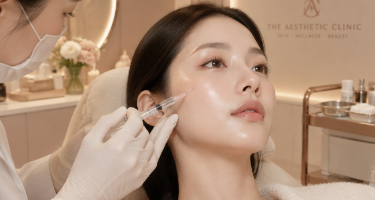
Rejuran, Juvelook, and Lituo — what’s actually different? — Three options, weighed against the evidence
DIORE CLINIC
4.8(400+)
📅 Last updated: July 2026
First, the bottom line: Rejuran (PN, salmon-derived), Juvelook (PDLLA+HA, synthetic), and Lituo (human ECM) are not three versions of one treatment, but completely different products that introduce different materials to make the skin do different things. There are still no clinical studies that directly compare all three head-to-head — so if someone claims one of the three is "the best," that is a statement about launch order, not evidence.
What is actually inside the syringe?
| Category | Rejuran | Juvelook | Lituo |
|---|---|---|---|
| Material | PN — Polynucleotide | PDLLA + HA | Human ECM (hADM) |
| Source | Salmon DNA (O. keta) | Synthetic polymer | Donated human dermis |
| Manufacturer | Pharmaresearch | Vaim Global | L&C Bio |
| Legal classification | Medical device | Medical device | Human tissue |
| Available overseas | Yes — EU MDR approved | Yes — CE, 60+ countries | Effectively no |
Most guides miss the last row of this table. Why it matters will be explained below.
Each product’s own bet on the skin
Rejuran — sends a repair signal to the skin
Pharmaresearch describes PN as a substance that induces tissue regeneration. Once injected, polynucleotides act like a kind of "repair signal" inside the skin, attracting and supplying water to the tissue, creating an environment in which skin cells can regenerate, and supporting fibroblasts that produce collagen and elastin.
The manufacturer explains that both PN and PDRN are regenerative medicine raw materials made of DNA fragments isolated from salmon testicular cells, and that PN has a longer nucleic acid chain than PDRN.
Working logic: The cells already have the ability to work — they just need to be told.
The product lineup is also subdivided: Rejuran Healer for texture and elasticity, Rejuran HB+ for hydration, and Rejuran i, a low-concentration version with a fine needle for the eye area.
Juvelook — creates a controlled construction site
Vaim positions Juvelook as a hybrid product. The HA component creates immediate moisture and radiance after injection, while the collagen induced by PDLLA forms slowly over the following weeks.
The particle design is especially interesting. Vaim has patented a PDLLA manufacturing technology that creates microparticles with a porous mesh structure, and according to the company, the design maximizes the surface area that induces collagen while minimizing the nodule risk that was a problem with older polylactic acid injectables. Unlike crystalline PLLA particles, which can cause granulomas if injected imprecisely, PDLLA uses amorphous spherical particles.
Working logic: If you gently stimulate the skin, it rebuilds itself. The result comes not from the injected material itself, but from the skin’s response.
Lituo — refills the structural material that has disappeared
Lituo does not send signals or create irritation. Instead, it directly replenishes human extracellular matrix in the dermis.
The composition reported in a Yonsei University clinical paper (Int J Mol Sci 2026;27(5):2193) is about 80% collagen, 3% elastin, and 0.4% sGAG, with residual DNA below 50ng/mg. Electron microscopy showed that even after particleization, the alignment of collagen fibers and the characteristic D-banding pattern were preserved — meaning the ECM structure itself withstood the particleization process.
In mouse model experiments, fibroblasts migrated into the matrix one week after injection, and new collagen formation was observed at the interface between the matrix and host tissue.
Working logic: If the scaffold that supported the structure has collapsed, supply the scaffold again.
Lituo’s ECM mechanism is discussed in more depth in the article "Putting collagen into the skin — Lituo and the ECM story."
In the end, these are three different bets
Strip away the branding, and each product is ultimately a different bet on "what is the problem with the skin right now."
| Product | Bet |
|---|---|
| Rejuran | The cells have become sluggish → send a signal |
| Juvelook | If stimulated, it rebuilds → stimulate precisely |
| Lituo | The structural material has been depleted → supply the material |
The problem is that none of these three bets has ever been directly tested against the others. Lituo’s only randomized clinical trial used non-crosslinked hyaluronic acid as the control group — not Rejuran and not Juvelook. The other two products also ran their own trials against their own separate controls.
Three consistent theories, three separate evidence bases, and zero direct comparisons. That is the honest state of this field as of 2026.
What are the manufacturers each targeting?
I can’t tell you which is better. But I can show you where each company says its product should be used, and you can see that the targets are different.

Rejuran (Pharmaresearch): skin texture, elasticity, hydration, fine wrinkles around the eyes — a lineup segmented by area and concentration.
Juvelook (Vaim): 50mg targets skin texture improvement, while the volume version (200mg) targets deeper volume replenishment. It is usually performed as a three-session course at one-month intervals, and the finer particles are suitable for thin, delicate areas such as under the eyes and around the mouth.
Lituo (L&C Bio): broadly targets dermal density, volume, elasticity, pore area, wrinkle depth, barrier function, and pigmentation. The Yonsei study found significant differences versus HA across these endpoints at multiple time points. The lineup is divided by particle size: the standard 100㎛ version for thicker areas and the approximately 50㎛ Fine version for thin skin.
If you read the three paragraphs again, it will become clear that they are not describing the same thing.
The timeline of results is different too — especially if you are flying in
| Onset | Practical meaning | |
|---|---|---|
| Rejuran | 3 to 4 sessions at 2 to 4 week intervals | Requires multiple visits |
| Juvelook | 3 sessions at one-month intervals | HA gives the early effect, collagen follows |
| Lituo | Clinical data extends to 20 weeks, with 3 months being the point at which it becomes equivalent | Shows the slowest visible change |
The last row of this table deserves the most emphasis, but it is also the part most clinics leave out when explaining it.
In a randomized clinical trial of 202 patients using microparticle ADM (Aesth Plast Surg 2026;50:3710–19), patient satisfaction at 6 weeks was significantly lower than in the collagen filler control group (67.4% vs 83.9%). Early pain was higher at 40.7% vs 10.1%, and swelling was higher at 45.4% vs 13.5%. But by 3 months, the difference disappeared and the results became similar (3 months 88.4% vs 85.4%, 6 months 70.9% vs 69.7%).
The authors explain this early response not as biology but as physics. Because mADM particles must be dense and firm for mechanical support, they require a 23G or 25G needle, not 27G. Of local adverse reactions, 78% resolved naturally without separate treatment.
If you are scheduled to fly back in 4 weeks, you will be at the lowest point of the curve. That is not a side effect — it is the original timeline. But because people are often not told this in advance, they sometimes think they have been misled. You have not been.
The line everyone skips: can you get it anywhere?
It helps to look at the table at the top again.
Rejuran crosses borders. It is the only PN-based medical device approved under the EU Medical Device Regulation (MDR), and it has European distribution agreements in 22 countries, including the UK, Germany, France, Italy, and Spain.
Juvelook also crosses borders. It has approval from Korea’s MFDS, EU CE certification, and Thailand FDA approval — but not U.S. approval yet.
Lituo does not cross borders — and that is a regulatory fact, not a marketing line.
Lituo is not classified as a medical device. In Korea, it is regulated as human tissue. Medical devices are exported through the medical-device pathway with product-specific indication approval, while human tissue operates under a completely different system — donor consent, tissue bank certification, lot-level traceability, and import rules that vary by country.
The Yonsei researchers explicitly state that, prior to their paper, there had been no clinical studies examining injectable hADM as a primary dermal scaffold. Because it is a new category, most countries have not yet created a cosmetic-use regulatory path for it.
In practical terms: PN and PDLLA can be received in London, Bangkok, and Milan. A human ECM booster, in this form, exists only where tissue-related legal systems allow it. Right now, that is Korea.
And that is exactly why Korea is now moving to strengthen the rules around it. As of March 2026, the MFDS is reviewing amendments that would restrict cosmetic advertising for human tissue products and require disclosure to patients that they are derived from human tissue.
A country that is making regulations stricter for a category is not a country that should be worried — it is closer to the opposite.
So which one should I get?
Most articles give you a fake answer here. We’ll show you the real boundary instead.
What the evidence supports:
- These materials do different things — established
- The manufacturers position them toward different goals — documented above
- Lituo outperformed non-crosslinked HA on multiple endpoints — Yonsei RCT, n=20, 20 weeks
- Microparticle ADM was equivalent to collagen filler at 3 and 6 months, with less product and fewer additional injections, but more early reactions — 202-patient RCT
What no one can substantiate:

- That one is better than the others
- That there is a generational hierarchy
- That one is right for a patient who has not been examined
What foreign patients asking for consultations in Gangnam also ask
Q. Can I get one of Rejuran, Juvelook, or Lituo together with lifting procedures like Ulthera or Thermage?
The principles are different. Rejuran, Juvelook, and Lituo are all on the "filling and regeneration" side, where material is supplied to or stimulation is applied to the dermis to help collagen formation. Ulthera (HIFU) and Thermage (RF) are on the "lifting" side, using thermal energy to contract and remodel deeper tissue. Because the layers and mechanisms do not overlap, they are often scheduled separately during the same visit period, but the order and interval should be decided after consultation based on skin condition.
Q. Is it better to get Sofwave or Ulthera first and Lituo later, or the other way around?
There are no direct clinical studies comparing that order yet. However, HIFU procedures such as Sofwave and Ulthera can cause temporary swelling and sensitivity changes immediately after treatment, so rather than doing another injection procedure in the same area right away, many clinics check recovery status during consultation and set the interval accordingly. For foreign patients in Gangnam who plan multiple procedures over a short stay, we especially recommend designing the full schedule together before treatment.
Q. If I only have a short stay, how can I make the most of Lituo’s effect?
If you refer to the timeline table above, Lituo is the product whose effects appear latest based on the 20-week clinical data. If you want quick changes during a short visit, you may also consider a product like Juvelook, where the HA component creates an immediate effect, or a lifting treatment such as Ulthera or Thermage, where firmness can be felt from right after the procedure. However, this also depends on individual skin condition, so we recommend aligning expectations during the pre-visit consultation.
How Diore approaches it
Adequate hydration and sun protection help recovery
There is no product-form answer. There is only the face.
Rejuran notes
Dermal thickness differs even within the same cheek. In the same treatment, on the same face, the temple may need structure while the eye area may need a signal. Skin whose main issue is pores and skin whose main issue is sagging can look the same in photos while requiring opposite answers.
It is hard to expect a dramatic change from a single session. The cumulative effect builds with repeated treatment
That is why we do not tell you the product before the examination. Not because it is a principle, but because it is impossible. The information needed to answer that question does not exist until we actually see the skin.
Because it is derived from human tissue, general allergic reactions are very rare, but temporary swelling and redness may occur
A clinic that tells you which booster you need from a photo or message is not diagnosing. It is taking an order.
Frequently asked questions
Which one is the best?
There is no study that directly compares them. Anyone who answers this question is guessing or selling.
Can I get Lituo in my country?
Almost certainly not. Not because it is exclusive, but because most countries have not extended the regulatory framework for human tissue products into the aesthetic space. In contrast, Rejuran and Juvelook are available in most of Europe and Asia.
Is human-derived tissue safe?
The raw material has a long history in reconstructive surgery. L&C Bio states that it uses tissue donated by U.S. donors with consent for cosmetic use, and that it undergoes AATB certification, FDA listing of the raw material, MFDS approval, viral inactivation, and mandatory lot-number recording at the time of transplantation. Even so, if this concept makes you uncomfortable, that is a perfectly valid reason to choose something else. Tell us, and we will design accordingly.
Can they be done together?
The order and interval depend on skin condition and schedule. This is not a menu question; it is a medical question.
How long does Lituo last?
Published follow-up ends at 20 weeks. Anything beyond that is unknown — including to us. If a clinic presents longer numbers, ask for the evidence.
This content is for informational purposes only, and treatment effects vary from person to person. All procedures should be decided after consultation with a specialist.
Diore Clinic | Premium Skin Aesthetic Clinic, Seoul
Direct treatment by the chief doctor · 1:1 personalized consultation
Latest Expert Guides
View allVision Correction
SMILE vs. PRK vs. ICL: What Are These Eye Surgeries?
EYEREUM Eye Clinic

Dermatology
Ultherapy in Hongdae, Seoul 300 vs. 600 Shots: Which Is Right for You?
Reverse Clinic Hongdae Branch

K-Beauty
A Review of Forehead Lift Surgery at Sinsa Station in Gangnam That Created a Brighter, Fresher Look
Luho Plastic Surgery
