Expert Guide

Filling treatments and regenerative treatments differ from the time results appear — filler vs collagen booster

DIORE CLINIC
4.8(400+)
Filling treatments and regenerative treatments differ from the time results appear
💡 At a glance
· Filler (hyaluronic acid) is an 'instant volume' treatment that fills in volume the moment it is injected.
· Collagen boosters (Radiesse·Sculptra) are 'delayed regenerative' treatments that stimulate your body to produce collagen on its own.
· In one sentence: if you want to fill a sunken area right away, choose filler; if your whole face feels like it has sagged downward, choose a collagen booster.
· Radiesse (CaHA) combines immediate volume replenishment with collagen stimulation, while Sculptra (PLLA) focuses more on generation than volume and gradually fills in over several months.
· Filler can be reversed with a dissolving enzyme, but collagen boosters have no reversal agent.
Why do people keep getting confused? — Because both are said to “fill in”
They are easy to confuse because both are injected and both are described as making the face look fuller. In consultations, we often hear, “Isn’t Sculptra just a filler?” However, the two do fundamentally different things inside the body. Filler itself becomes the volume and takes up space, while with a collagen booster, the product itself gradually disappears and leaves behind collagen created by your own tissue. That means the timing of results, how long they last, and how to respond if something goes wrong are all different.
What is filler (hyaluronic acid)?
Filler (HA filler, hyaluronic acid filler, ヒアルロン酸フィラー, 玻尿酸填充, 玻尿酸填充劑) is a procedure that turns hyaluronic acid, which is also found in the body, into a gel form and directly fills sunken areas. Hyaluronic acid strongly attracts water, so the moment it is injected, it creates volume equal to that space. The key points are speed of response and reversibility. You can see the change immediately after the procedure, and if you do not like the shape or if a side effect occurs, it can be dissolved with hyaluronidase (hyaluronic acid-dissolving enzyme). Having an 'eraser' is the biggest safety feature of filler. It is mainly used in clearly defined areas of location and shape, such as nasolabial folds, aegyo-sal, under-eye hollows, contour areas like the chin and nose, and lip volume. Depending on the product, it lasts about 6–18 months and is then broken down by enzymes in the body.
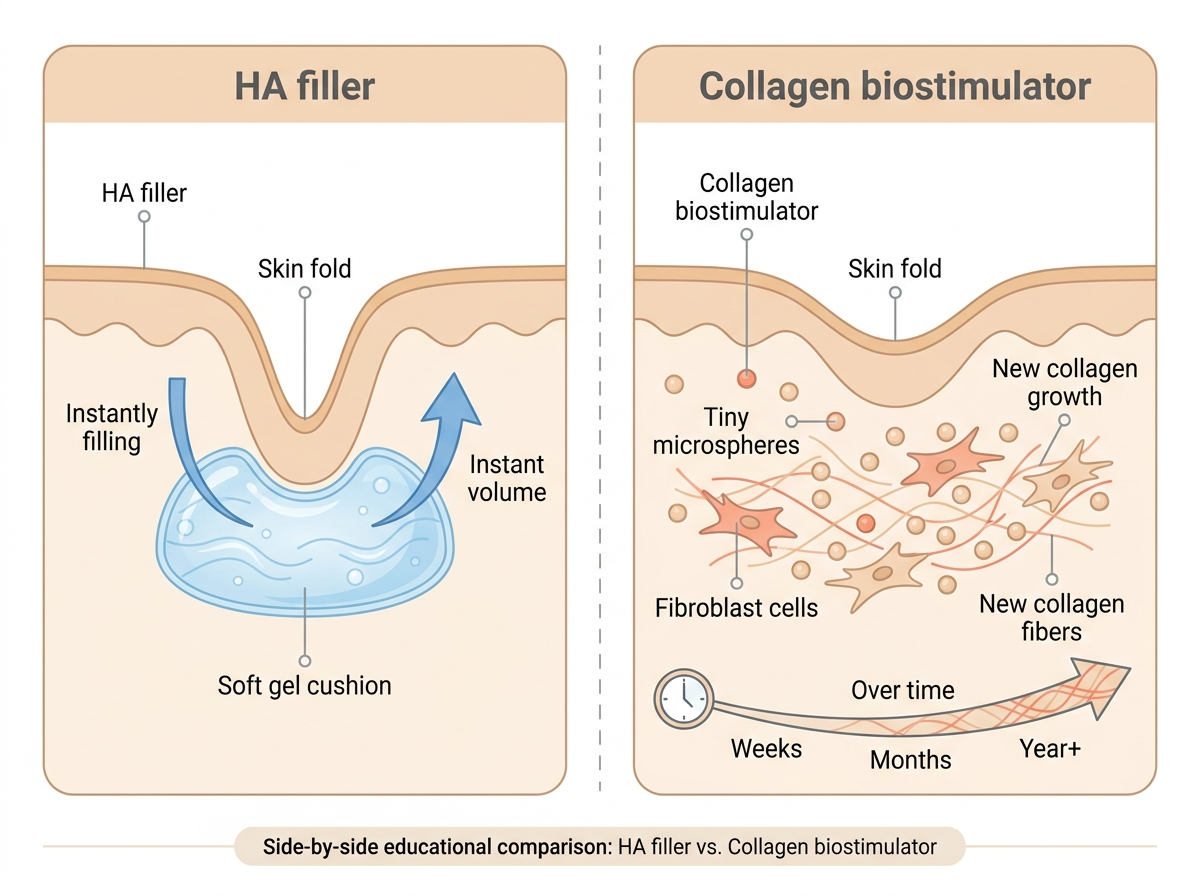 A cross-sectional diagram comparing how hyaluronic acid filler immediately fills volume and how a collagen booster stimulates fibroblasts to create new collagen
Filler occupies space, while a collagen booster prompts the tissue to fill itself.
What is a collagen booster (Radiesse·Sculptra)?
A collagen booster (biostimulator, collagen biostimulator, コラーゲンブースター, 胶原蛋白再生剂) is an injectable that does not directly create volume with the product itself, but instead stimulates fibroblasts in the dermis (the cells that make collagen) to produce new collagen. The two 대표 examples are Radiesse (CaHA, calcium hydroxyapatite) and Sculptra (PLLA, poly-L-lactic acid). Radiesse is a structure in which tiny calcium-based microspheres float in a gel. The gel first fills in volume, and then the microspheres stimulate fibroblasts to induce collagen. In a study by Yutskovskaya and colleagues, type I and III collagen increased significantly at 8 and 12 months after diluted Radiesse treatment, and elastin production was also observed starting at 4 months. Sculptra (PLLA) is a component used in surgical absorbable sutures; it produces very little immediate volume and slowly builds collagen over several months. In Goldberg and colleagues' clinical study, type I collagen increased by about 65.5% three months after PLLA treatment. The FDA clinical protocol for Sculptra involved up to 4 treatments at 3-week intervals, and the effect was reported to last up to 25 months after the final treatment.
Key comparison table
| Comparison item | Filler (HA) | Radiesse (CaHA) | Sculptra (PLLA) |
|---|---|---|---|
| Main ingredient | Hyaluronic acid | Calcium hydroxyapatite | Poly-L-lactic acid |
| Mechanism | Absorbs water to fill space | Volume replenishment + collagen stimulation | Mainly induces collagen production |
| Onset of effect | Immediately | Immediately + regenerative effect from 2–3 months | Gradual from 6–8 weeks |
| Duration of effect | About 6–18 months | About 12–18 months | Reported up to 25 months |
| Main indications | Nasolabial folds, aegyo-sal, contour design | Jawline·neck·back of hands elasticity, widespread sagging | Overall facial volume loss, hollowed look |
| Treatment time | 15–30 min | 20–30 min | 20–30 min |
| Downtime | Swelling·bruising 2–5 days | Swelling·bruising 2–5 days | Swelling·bruising 2–5 days |
| Recommended number of sessions | 1 session, with correction if needed | 1–2 sessions | 2–4 sessions at 4–6 week intervals |
| Reversibility | Possible (enzyme injection) | Not possible | Not possible |
| Cost | Consultation required | Consultation required | Consultation required |
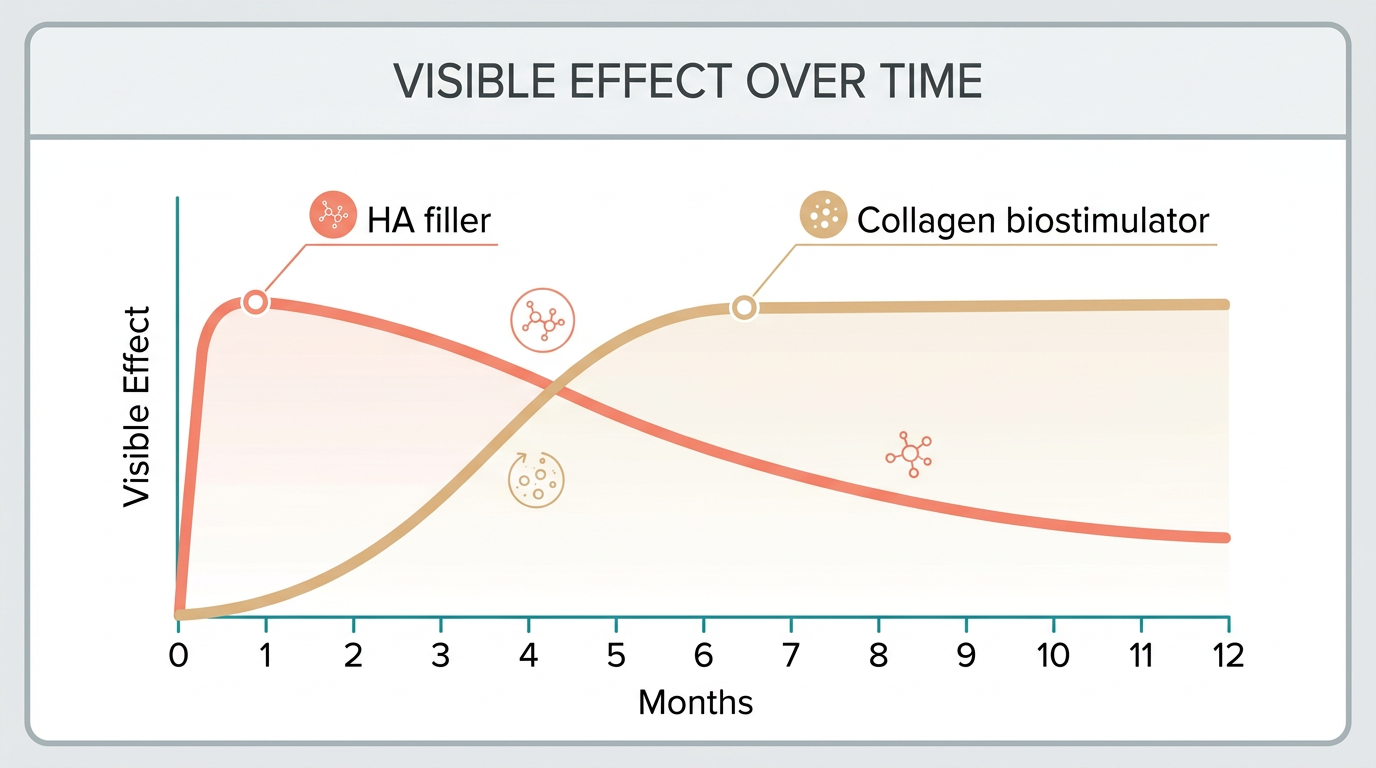 A time-course graph showing that filler is at its peak immediately after treatment and then gradually decreases, while a collagen booster rises over several months

Even though the goal is the same — to “fill” — the shape of the graph over time is completely different.
Which treatment is right for me?
Who is a good candidate for filler
- People with clearly defined sunken areas, such as nasolabial folds or aegyo-sal
- People who want contour design for the chin tip or nose tip
- People who need fast results because an important event is within 2–3 weeks
- People trying injectable treatment for the first time (less psychological 부담 because it can be reversed)
Who is a good candidate for a collagen booster
- People worried that their whole face feels like it has sagged downward rather than having a specific wrinkle
- People who are told they suddenly look older after losing weight
- People who want management on a monthly to yearly basis rather than repeated procedures
- People who want to improve skin texture over a wide area such as the neck, décolleté, or back of the hands (mainly diluted Radiesse)
If you are choosing between Sculptra and Radiesse, the deciding factor is how much starting volume is needed. If there is significant volume loss and you need some support from the start, Radiesse is suitable; if you want a natural, gradual fill without abrupt change, Sculptra is a better fit.
Useful treatment combinations
In real-world practice, rather than choosing only one of the two, the roles are often divided. A collagen booster is used to strengthen the overall foundation of the face, while filler is used to finish areas that are more difficult or require precise contouring. It can also be combined with lifting devices such as Ulthera and Thermage (HIFU·radiofrequency), but heat-based treatments can affect the injected product, so the sequence and spacing need to be planned.
DIORE clinical principle
In our clinic, when we recommend a collagen booster, we do not promise a change that will be visible this month. Collagen regeneration is a physiological process and takes time, and if expectations are not set accurately in advance, it can lead to the misunderstanding that “it doesn’t work.” On the other hand, for people with a wedding or other important event coming up soon, we do not recommend a collagen booster that takes time. Another point is that because there is no reversal agent for collagen boosters, we take a conservative approach to the injection depth and amount. It is easier to add more at the next session if there is not enough, but it is difficult to reverse if too much is placed.
Frequently asked questions from international patients seeking consultation in Gangnam
Radiesse and Sculptra are treatments whose results vary greatly depending on dilution ratio, hydration time, and injection depth. If you are consulting near Gangnam Station, we recommend checking not only whether genuine products are used, but also whether the plan is designed after evaluating the volume loss from an overall facial perspective. At DIORE Clinic, Seoul, our dermatology-aesthetic medical team first assesses facial volume distribution, then plans the roles of filler and collagen booster separately, and we also operate foreign-language consultation channels for overseas patients. For those with a short stay, we design plans centered on Radiesse or filler that can be completed in 1–2 sessions; for those with more time, we also consider the gradual regenerative effect of Sculptra. If you would like to compare regenerative treatments more broadly, you can also consult about Rejuran based on PDRN, and because its mechanism of action is different, it is often designed as a complementary treatment.

Frequently asked questions
Q1. When does Sculptra start showing results after treatment?
Usually you begin to feel changes after 6–8 weeks, and it gradually fills in over 3–6 months. Right after the procedure, it may look temporarily fuller because of water uptake, then settle down within a few days, which many people mistake for the effect having gone away. The real effect rises after that.
Q2. Between Radiesse and filler, which is better for the jawline?
If the jawline has weakened because of both volume loss and skin laxity, Radiesse is advantageous because it also improves elasticity. If the goal is precise refinement of the chin tip and aegyo-sal, filler is more suitable. Combining the two is also common.
Q3. Can a collagen booster be dissolved like filler?
No. Only hyaluronic acid filler can be dissolved with an enzyme. Radiesse and Sculptra have no dissolving enzyme. That is why it is important to design the injection depth and amount conservatively from the start.
Q4. I’m in my early 30s — do I already need a collagen booster?
Because collagen decreases by about 1% per year starting in the late 20s, beginning in your early 30s is not meaningless. However, at this stage, hydration, barrier care, and sunscreen usually make a bigger difference. We recommend deciding after evaluating whether actual volume loss is present.
Q5. Should I massage my face after the procedure?
With Sculptra, massage may be recommended for several days after treatment so the product spreads evenly. With filler, on the contrary, touching it may distort the shape, so the general rule is not to manipulate it. This varies by product and treatment area, so be sure to follow the instructions of the clinic where you were treated.
Conclusion
Filler and collagen boosters are not competing treatments but tools with different roles. If there is a clear “sunken area,” filler is the starting point; if the issue is that the face has become generally depleted, a collagen booster is the starting point. Which one to do first should be decided based on the overall facial volume distribution, because choosing the wrong order can lead to unnecessary cost and unclear results.
ℹ️ This content is intended to provide general medical information and does not replace individual consultation. Treatment results may vary depending on each person's skin condition, and accurate diagnosis and consultation should be conducted with a dermatology-aesthetic medical professional.
References
- Goldberg D, et al. Injectable poly-L-lactic acid: collagen stimulation data (cited again by Avelar LE, et al., Journal of Cosmetic Dermatology. 2025).
- Yutskovskaya Y, Kogan E, Leshunov E. A randomized, split-face, histomorphologic study comparing a volumetric calcium hydroxylapatite and a hyaluronic acid-based dermal filler. J Drugs Dermatol. 2014.
- Sculptra Aesthetic FDA Summary of Safety and Effectiveness Data (P030050/S002).
- The Role of Calcium Hydroxylapatite (Radiesse) as a Regenerative Aesthetic Treatment: A Narrative Review. Aesthetic Surgery Journal. 2023;43(10):1063.
Latest Expert Guides
View allVision Correction
SMILE vs. PRK vs. ICL: What Are These Eye Surgeries?
EYEREUM Eye Clinic

Dermatology
Ultherapy in Hongdae, Seoul 300 vs. 600 Shots: Which Is Right for You?
Reverse Clinic Hongdae Branch

K-Beauty
A Review of Forehead Lift Surgery at Sinsa Station in Gangnam That Created a Brighter, Fresher Look
Luho Plastic Surgery
